Babylon Took Jerusalem

God warned His people because of their rebellion difficult times were coming. When Zedekiah was king, King Nebuchadnezzar of Babylon burned down the city of Jerusalem and took the people captive.

2 Kings 25:

On August 14 of that year, which was the nineteenth year of King Nebuchadnezzar’s reign, Nebuzaradan, the captain of the guard and an official of the Babylonian king, arrived in Jerusalem. He burned down the Temple of the Lord, the royal palace, and all the houses of Jerusalem. He destroyed all the important buildings[b]in the city. 10 Then he supervised the entire Babylonian army as they tore down the walls of Jerusalem on every side. 11 Then Nebuzaradan, the captain of the guard, took as exiles the rest of the people who remained in the city, the defectors who had declared their allegiance to the king of Babylon, and the rest of the population. 12 But the captain of the guard allowed some of the poorest people to stay behind to care for the vineyards and fields.

13 The Babylonians broke up the bronze pillars in front of the Lord’s Temple, the bronze water carts, and the great bronze basin called the Sea, and they carried all the bronze away to Babylon.14 They also took all the ash buckets, shovels, lamp snuffers, ladles, and all the other bronze articles used for making sacrifices at the Temple. 15 The captain of the guard also took the incense burners and basins, and all the other articles made of pure gold or silver.

16 The weight of the bronze from the two pillars, the Sea, and the water carts was too great to be measured. These things had been made for the Lord’s Temple in the days of Solomon. 17 Each of the pillars was 27 feet[c] tall. The bronze capital on top of each pillar was 7 1⁄2 feet[d] high and was decorated with a network of bronze pomegranates all the way around.

18 Nebuzaradan, the captain of the guard, took with him as prisoners Seraiah the high priest, Zephaniah the priest of the second rank, and the three chief gatekeepers. 19 And from among the people still hiding in the city, he took an officer who had been in charge of the Judean army; five of the king’s personal advisers; the army commander’s chief secretary, who was in charge of recruitment; and sixty other citizens. 20 Nebuzaradan, the captain of the guard, took them all to the king of Babylon at Riblah. 21 And there at Riblah, in the land of Hamath, the king of Babylon had them all put to death. So the people of Judah were sent into exile from their land.

Standard

Idol Destroyer

Josiah was a great king of Judah. The Bible likens him to King David. He did a difficult task and destroyed idols. This passage from the Bible goes into details what he had to do to remove idol worship and honor God again. It would be interesting to count all the things Josiah did to stop the people from worshipping false gods. He even destroyed shrines to Ashteroth that we’re built by ‘the wise’ King Solomon.  We should strive to be like him and turn to God with all our heart, soul and might.
2 Kings 23:

23 Then the king summoned all the elders of Judah and Jerusalem.And the king went up to the Temple of the Lord with all the people of Judah and Jerusalem, along with the priests and the prophets—all the people from the least to the greatest. There the king read to them the entire Book of the Covenant that had been found in the Lord’s Temple. The king took his place of authority beside the pillar and renewed the covenant in the Lord’s presence. He pledged to obey the Lord by keeping all his commands, laws, and decrees with all his heart and soul. In this way, he confirmed all the terms of the covenant that were written in the scroll, and all the people pledged themselves to the covenant.

Then the king instructed Hilkiah the high priest and the priests of the second rank and the Temple gatekeepers to remove from the Lord’s Temple all the articles that were used to worship Baal, Asherah, and all the powers of the heavens. The king had all these things burned outside Jerusalem on the terraces of the Kidron Valley, and he carried the ashes away to Bethel. He did away with the idolatrous priests, who had been appointed by the previous kings of Judah, for they had offered sacrifices at the pagan shrines throughout Judah and even in the vicinity of Jerusalem. They had also offered sacrifices to Baal, and to the sun, the moon, the constellations, and to all the powers of the heavens. The king removed the Asherah pole from the Lord’s Temple and took it outside Jerusalem to the Kidron Valley, where he burned it. Then he ground the ashes of the pole to dust and threw the dust over the graves of the people. He also tore down the living quarters of the male and female shrine prostitutes that were inside the Temple of the Lord, where the women wove coverings for the Asherah pole.

Josiah brought to Jerusalem all the priests who were living in other towns of Judah. He also defiled the pagan shrines, where they had offered sacrifices—all the way from Geba to Beersheba. He destroyed the shrines at the entrance to the gate of Joshua, the governor of Jerusalem. This gate was located to the left of the city gate as one enters the city. The priests who had served at the pagan shrines were not allowed to serve at[a] the Lord’s altar in Jerusalem, but they were allowed to eat unleavened bread with the other priests.

10 Then the king defiled the altar of Topheth in the valley of Ben-Hinnom, so no one could ever again use it to sacrifice a son or daughter in the fire  as an offering to Molech.11 He removed from the entrance of the Lord’s Temple the horse statues that the former kings of Judah had dedicated to the sun. They were near the quarters of Nathan-melech the eunuch, an officer of the court.[c]The king also burned the chariots dedicated to the sun.

12 Josiah tore down the altars that the kings of Judah had built on the palace roof above the upper room of Ahaz. The king destroyed the altars that Manasseh had built in the two courtyards of the Lord’s Temple. He smashed them to bits and scattered the pieces in the Kidron Valley. 13 The king also desecrated the pagan shrines east of Jerusalem, to the south of the Mount of Corruption, where King Solomon of Israel had built shrines for Ashtoreth, the detestable goddess of the Sidonians; and for Chemosh, the detestable god of the Moabites; and for Molech, the vile god of the Ammonites. 14 He smashed the sacred pillars and cut down the Asherah poles. Then he desecrated these places by scattering human bones over them.

15 The king also tore down the altar at Bethel—the pagan shrine that Jeroboam son of Nebat had made when he caused Israel to sin. He burned down the shrine and ground it to dust, and he burned the Asherah pole. 16 Then Josiah turned around and noticed several tombs in the side of the hill. He ordered that the bones be brought out, and he burned them on the altar at Bethel to desecrate it. (This happened just as the Lord had promised through the man of God when Jeroboam stood beside the altar at the festival.)

Then Josiah turned and looked up at the tomb of the man of God who had predicted these things.17 “What is that monument over there?” Josiah asked.

And the people of the town told him, “It is the tomb of the man of God who came from Judah and predicted the very things that you have just done to the altar at Bethel!”

18 Josiah replied, “Leave it alone. Don’t disturb his bones.” So they did not burn his bones or those of the old prophet from Samaria.

19 Then Josiah demolished all the buildings at the pagan shrines in the towns of Samaria, just as he had done at Bethel. They had been built by the various kings of Israel and had made the Lord[g] very angry.20 He executed the priests of the pagan shrines on their own altars, and he burned human bones on the altars to desecrate them. Finally, he returned to Jerusalem.

21 King Josiah then issued this order to all the people: “You must celebrate the Passover to the Lordyour God, as required in this Book of the Covenant.” 22 There had not been a Passover celebration like that since the time when the judges ruled in Israel, nor throughout all the years of the kings of Israel and Judah. 23 But in the eighteenth year of King Josiah’s reign, this Passover was celebrated to the Lord in Jerusalem.

24 Josiah also got rid of the mediums and psychics, the household gods, the idols, and every other kind of detestable practice, both in Jerusalem and throughout the land of Judah. He did this in obedience to the laws written in the scroll that Hilkiah the priest had found in the Lord’s Temple. 25 Never before had there been a king like Josiah, who turned to the Lord with all his heart and soul and strength, obeying all the laws of Moses. And there has never been a king like him since.

26 Even so, the Lord was very angry with Judah because of all the wicked things Manasseh had done to provoke him. 27 For the Lord said, “I will also banish Judah from my presence just as I have banished Israel. And I will reject my chosen city of Jerusalem and the Temple where my name was to be honored.”
Standard

Healed

King Hezekiah of Judah honored God during his reign. God healed him of an illness.

2 Kings 20:

1 About that time Hezekiah became deathly ill, and the prophet Isaiah son of Amoz went to visit him. He gave the king this message: “This is what the Lord says: Set your affairs in order, for you are going to die. You will not recover from this illness.”

When Hezekiah heard this, he turned his face to the wall and prayed to the Lord, “Remember, O Lord, how I have always been faithful to you and have served you single-mindedly, always doing what pleases you.” Then he broke down and wept bitterly.

But before Isaiah had left the middle courtyard, this message came to him from the Lord: “Go back to Hezekiah, the leader of my people. Tell him, ‘This is what the Lord, the God of your ancestor David, says: I have heard your prayer and seen your tears. I will heal you, and three days from now you will get out of bed and go to the Temple of the Lord. I will add fifteen years to your life, and I will rescue you and this city from the king of Assyria. I will defend this city for my own honor and for the sake of my servant David.’”

Then Isaiah said, “Make an ointment from figs.” So Hezekiah’s servants spread the ointment over the boil, and Hezekiah recovered!

Meanwhile, Hezekiah had said to Isaiah, “What sign will the Lord give to prove that he will heal me and that I will go to the Temple of the Lord three days from now?”

Isaiah replied, “This is the sign from the Lord to prove that he will do as he promised. Would you like the shadow on the sundial to go forward ten steps or backward ten steps?”

10 “The shadow always moves forward,” Hezekiah replied, “so that would be easy. Make it go ten steps backward instead.” 11 So Isaiah the prophet asked the Lord to do this, and he caused the shadow to move ten steps backward on the sundial of Ahaz!

Standard

Ready

Agabas prophesied over Paul and told him he would be persecuted in Jerusalem.

Acts 21:

10 Several days later a man named Agabus, who also had the gift of prophecy, arrived from Judea. 11 He came over, took Paul’s belt, and bound his own feet and hands with it. Then he said, “The Holy Spirit declares, ‘So shall the owner of this belt be bound by the Jewish leaders in Jerusalem and turned over to the Gentiles.’” 12 When we heard this, we and the local believers all begged Paul not to go on to Jerusalem.

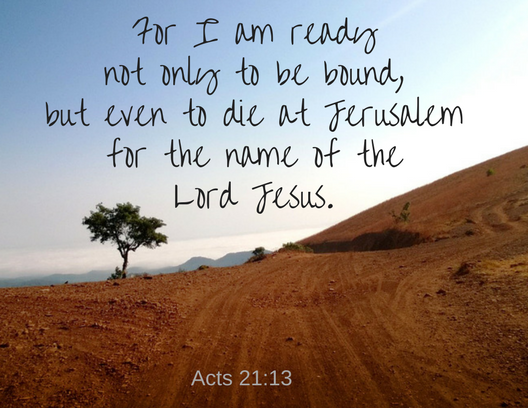
13 But he said, “Why all this weeping? You are breaking my heart! I am ready not only to be jailed at Jerusalem but even to die for the sake of the Lord Jesus.” 14 When it was clear that we couldn’t persuade him, we gave up and said, “The Lord’s will be done.”

15 After this we packed our things and left for Jerusalem. 16 Some believers from Caesarea accompanied us, and they took us to the home of Mnason, a man originally from Cyprus and one of the early believers. 17 When we arrived, the brothers and sisters in Jerusalem welcomed us warmly.

Standard

Sleeper

Eutichus fell asleep during Paul’s sermon but then a serious turn of event occurred.

Acts 9:

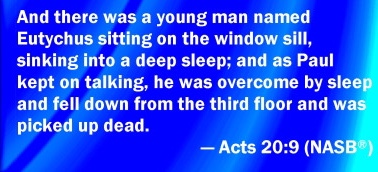
On the first day of the week, we gathered with the local believers to share in the Lord’s Supper. Paul was preaching to them, and since he was leaving the next day, he kept talking until midnight. The upstairs room where we met was lighted with many flickering lamps. As Paul spoke on and on, a young man named Eutychus, sitting on the windowsill, became very drowsy. Finally, he fell sound asleep and dropped three stories to his death below. 10 Paul went down, bent over him, and took him into his arms. “Don’t worry,” he said, “he’s alive!” 11 Then they all went back upstairs, shared in the Lord’s Supper, and ate together. Paul continued talking to them until dawn, and then he left. 12 Meanwhile, the young man was taken home alive and well, and everyone was greatly relieved.

Standard

Some Jews tried to cast out demons using the name of Jesus in incantations but the demons did not respond.

Acts 19:

13 A group of Jews was traveling from town to town casting out evil spirits. They tried to use the name of the Lord Jesus in their incantation, saying, “I command you in the name of Jesus, whom Paul preaches, to come out!”14 Seven sons of Sceva, a leading priest, were doing this. 15 But one time when they tried it, the evil spirit replied, “I know Jesus, and I know Paul, but who are you?” 16 Then the man with the evil spirit leaped on them, overpowered them, and attacked them with such violence that they fled from the house, naked and battered.

17 The story of what happened spread quickly all through Ephesus, to Jews and Greeks alike. A solemn fear descended on the city, and the name of the Lord Jesus was greatly honored.18 Many who became believers confessed their sinful practices. 19 A number of them who had been practicing sorcery brought their incantation books and burned them at a public bonfire. The value of the books was several million dollars. 20 So the message about the Lord spread widely and had a powerful effect.

Standard

Synagogue Boldness

Apollos was an eloquent speaker for God. He spoke boldly in the Jewish synagogue that Jesus was the Messiah.

Acts 18:

24 Meanwhile, a Jew named Apollos, an eloquent speaker who knew the Scriptures well, had arrived in Ephesus from Alexandria in Egypt. 25 He had been taught the way of the Lord, and he taught others about Jesus with an enthusiastic spirit and with accuracy. However, he knew only about John’s baptism. 26 When Priscilla and Aquila heard him preaching boldly in the synagogue, they took him aside and explained the way of God even more accurately.

27 Apollos had been thinking about going to Achaia, and the brothers and sisters in Ephesus encouraged him to go. They wrote to the believers in Achaia, asking them to welcome him. When he arrived there, he proved to be of great benefit to those who, by God’s grace, had believed. 28 He refuted the Jews with powerful arguments in public debate. Using the Scriptures, he explained to them that Jesus was the Messiah.

Standard

Vast Greatness

God’s greatness is overwhelming. He should be greatly praised.

Psalm 145:

I will exalt you, my God and King,
    and praise your name forever and ever.
I will praise you every day;
    yes, I will praise you forever.
Great is the Lord! He is most worthy of praise!
    No one can measure his greatness.

Let each generation tell its children of your mighty acts;
    let them proclaim your power.
I will meditate on your majestic, glorious splendor
    and your wonderful miracles.
Your awe-inspiring deeds will be on every tongue;
    I will proclaim your greatness.
Everyone will share the story of your wonderful goodness;
    they will sing with joy about your righteousness.

Standard